
Here’s What Really Leads to a Packed Dance Floor: Secrets from a 20-Year NJ Wedding DJ
Listen on Apple Podcasts | Spotify | YouTube
From the outside looking in, it can seem like a wedding DJ’s job is simply choosing great music and keeping the dance floor moving.
But that gap between what guests see and what’s actually happening behind the booth is exactly why so many couples underestimate how much the DJ shapes the night. Hire based on that surface-level picture alone, and you risk ending up with half-empty dance floors, awkward pauses, and a reception that never quite finds its rhythm.
In Episode 10 of We Love That For You, hosts Chris and Jackie sit down with Limelight Entertainment event host Jason, a 20-year veteran of the tri-state wedding scene, to pull back the curtain on what a great wedding DJ actually does. The conversation covers everything from reading a room full of strangers to negotiating a “must-play” list against a dance floor that has other plans.
If you’re planning a wedding and want a smooth timeline, a packed dance floor, and a night your guests are still talking about a year later, here’s what you need to know — and it starts with understanding that the DJ booth is really a command center, not a jukebox.


What Does a Wedding DJ Actually Do?
Long before the first guest arrives, a wedding DJ has already done hours of invisible work: emails, phone calls, timeline documents, and site visits to venues they’ve never visited before. Jason described calling ahead to unfamiliar venues just to confirm load-in logistics, sightlines for the ceremony microphone, and where to set up so speakers cover every seat evenly — not just the ones closest to the booth.
During the event itself, the DJ is functioning less like a performer and more like a conductor. They’re:
- Managing the timeline — keeping toasts, dances, and dinner service moving on schedule
- Coordinating with other vendors — the photographer, videographer, catering team, and maître d’ all need to move in sync
- Guiding the guest experience — making announcements so guests know what’s coming next instead of wandering off at the wrong moment
- Creating flow — stringing together ceremony, cocktail hour, and reception so the energy builds instead of resetting
As Jason put it, nobody’s there for the DJ. They’re there to make sure the couple’s vision comes together while staying invisible enough that guests only notice when something goes right.
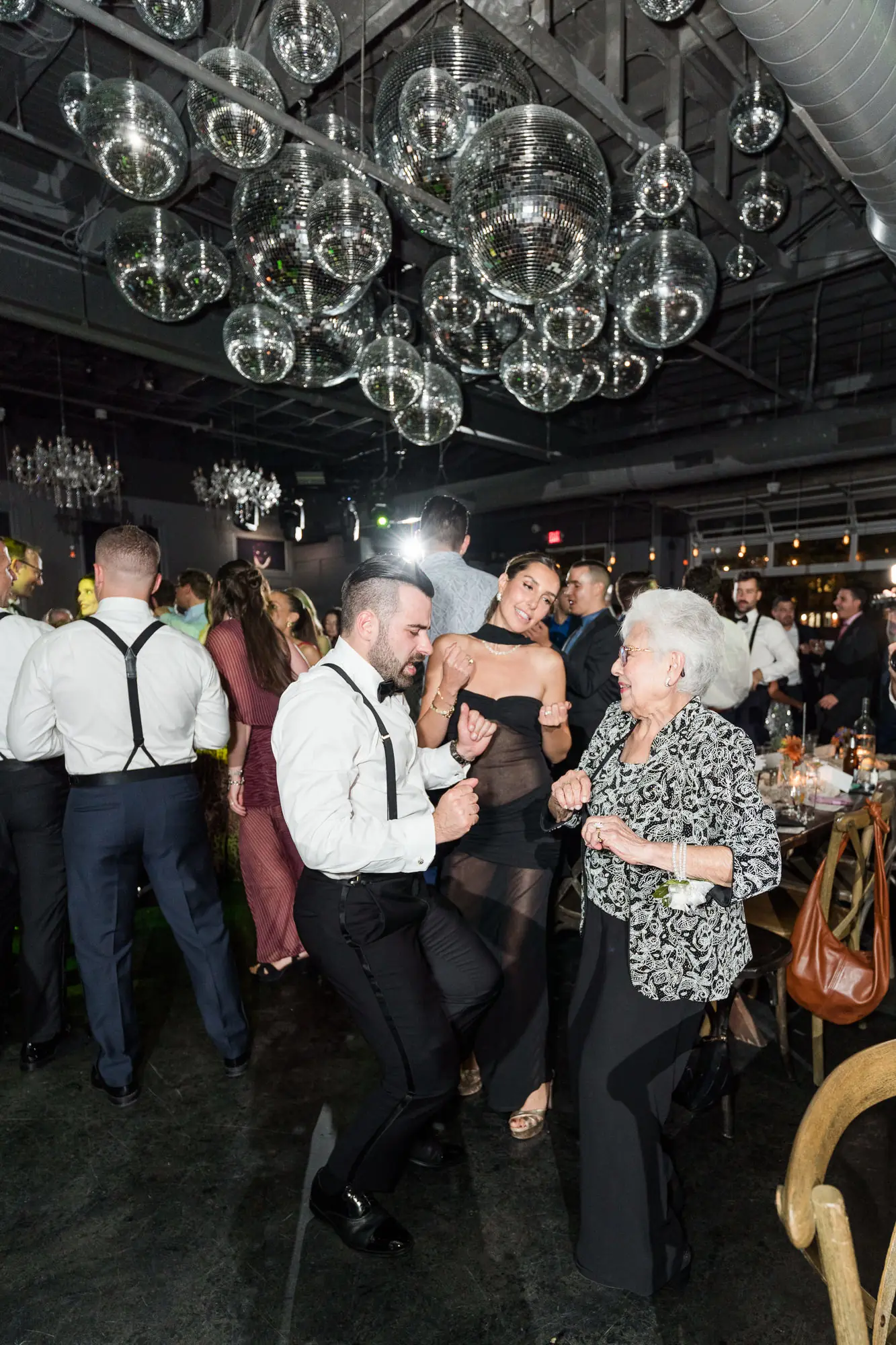


Why Reading the Room Matters
The single biggest skill separating a wedding professional from someone with a laptop playing at the bars is the ability to read a room in real time.
Jason’s approach: don’t just watch the people already dancing but watch the ones who aren’t. The guests still in their seats, tapping a foot or swaying slightly to the beat, are the real opportunity. Pick them off one at a time, song by song, and the dance floor builds itself organically instead of feeling forced.
That kind of read only comes from experience. It means noticing:
- Which guests are “bopping in their chairs” and just need the right song to get up
- Where the natural energy shifts happen throughout the night
- When to pivot away from a planned song list because it isn’t landing
- How to build momentum instead of demanding it with a microphone


How Great DJs Keep Dance Floors Packed
A packed dance floor isn’t luck — it’s crowd psychology applied in real time. Jason shared a few of the techniques that come up again and again:
Open with a slow song. Rather than launching straight into high-energy tracks after dinner, Jason likes to open the dance sets with a slow song and invite couples out to the floor. It eases guests into the energy instead of shocking them into it, and it reliably pulls 80–90% of the room out of their seats before the tempo picks up.
Balance genres by the hour. Classic songs from the 60s, 70s, and 80s tend to work best earlier in the night, when older relatives are still around and want music they can connect to. Later in the night, as younger guests take over the floor, the set can shift toward more contemporary hits — though even younger guests, Jason noted, often love the classics because they grew up hearing them from their parents.
Don’t force an empty floor. If the dance floor is slow to fill, maybe guests are still catching up at tables or the bridal party is at the bar; the fix isn’t announcements or pressure. It’s patience. Keep mixing, keep testing songs, and wait for two people to take the floor. Once there’s a second person, a crowd starts to form on its own.
Lean on the reliable songs. Every DJ has a mental list of tracks that work on almost any dance floor, regardless of the crowd. Weaving these in around more personal requests keeps the energy high while still honoring the couple’s taste.


The Biggest Entertainment Mistakes Couples Make
Some of the most common regrets Jason sees aren’t about music choice — they’re about structure. A few patterns that consistently hurt the reception:
Too many interruptions. Formalities like toasts, parent dances, and bouquet tosses are important, but scattering them throughout the night, instead of front-loading them early, breaks up the dance floor again and again. Every time guests sit back down for a formality, the DJ has to rebuild momentum from scratch. Jason suggests planning for most formal events to take place up front, this way the flow of the evening makes sense.
Overly restrictive playlists. A detailed “must-play” list is helpful, but a list that’s too long or too narrow (all one era, all one genre) can backfire if it doesn’t match what actually gets the room moving.
Pulling guests out of the room. A bar located outside the reception space, a cigar roller stationed on the patio, or fireworks that clear the room at the exact peak of the dance floor’s energy, these all pull guests away right when the party is working. Jason described one wedding where fireworks emptied the room during the best moment of the night, and the energy never fully recovered afterward.
The fix is simple: talk to your DJ before the day about anything that might pull guests out of the reception space. A quick conversation can turn a potential energy killer (cigar roller outside) into a non-issue (cigar roller set up just off to the side of the dance floor, inside the room).


The Importance of Trusting Your DJ
Every couple wants their favorite songs played. That’s normal, and reasonable. But Jason was candid about what happens when a must-play list becomes a rulebook: sometimes the songs a couple loves simply don’t work for a live room full of different guests, ages, and tastes.
He shared a story about a bride who sent over several playlists totaling roughly a hundred songs. When the dance floor stayed empty, Jason tested a different track while she was changing outfits and the floor filled instantly. When she returned and asked for her original list again, the floor emptied out again too. He honored her wishes because it was her day, but it’s a clear example of why flexibility matters.
His advice to couples: build your must-play list, but also build trust. A “do not play” list, in his experience, matters even more than the must-plays. It’s a hard boundary, while the must-play list works best as a strong suggestion the DJ can weave in around what actually keeps people dancing.
Couples who say “you’re the professional, read the room” tend to walk away with the best nights. Not because they gave up control, but because they gave their DJ room to do the job they hired them for.


Behind-the-Scenes Communication Couples Never See
Long before the wedding day, a good wedding DJ is running a quiet, ongoing coordination effort:
- Venue calls to confirm setup logistics, especially at unfamiliar locations
- Vendor teamwork with photographers, videographers, and the catering team to avoid stepping on each other’s timing
- Final planning calls roughly a month out, where the DJ and couple walk through the entire day, document in hand, from ceremony to last song
- Ongoing logistics management, including staying reachable by phone or text for last-minute changes
That final call is where a lot of the “read the room” conversation happens ahead of time. Jason uses it to set expectations: he’ll play the couple’s favorites where they fit, but if certain songs aren’t working for the dance floor, he’ll pivot toward what he knows performs and loop back to their picks around that.


What Makes a Great Wedding Reception
When you strip away the formalities and the vendor logistics, what guests actually remember is simpler: did they have fun, and did the couple look like they were having fun too?
Jason’s benchmark for a successful night: a dance floor that’s still full at the very end, guests who stick around to say goodbye instead of trickling out early, and one last song where everyone circles up around the couple. For his weddings in the tri-state area, that’s often “New York, New York” , a song, he noted, that never fails to bring a room together for one final moment.
The formula, in the end, isn’t complicated: guest engagement, smooth transitions between formalities and dancing, a packed floor, and a strong finish. Everything else, the timeline coordination, the vendor communication, the crowd-reading, exists to protect those four things.
Full Episode Transcript: The Wedding DJ Secret: What Great DJs Notice That Couples Never See
Full Episode Transcript
00:00 Welcome to We Love That For You, a wedding podcast with personality, perspective, and plenty of heart. We are Chris and Jackie from Limelight Entertainment, and we’re here to help you plan your best day ever, without the stress.
00:14 Welcome back to another episode of We Love That For You. Today we’re sitting down with our event host Jason. Jason brings a level of experience that comes from decades of reading rooms and knowing exactly how to build energy in real time.
00:26 When it comes to your wedding, your DJ isn’t just controlling the music — they’re setting the tone, managing the energy, and helping the entire night unfold the way it’s supposed to.
00:36 Jason has spent 20 years behind the DJ booth performing all over the tri-state area, working with a wide range of artists and producers. That background gives him a real strong instinct for what people connect with and how to build energy in a way that feels natural, not forced.
00:52 So this is your chance to get a feel for who Jason is, how he approaches the wedding day, and what it would be like to have him as your event host.
01:01 All right, welcome Jason! Thanks for coming, thanks for taking time out of your Saturday afternoon for us.
01:14 Glad to be here, thanks guys. This is cool, we love it.
01:22 So we want to give the opportunity for people to get to know you a little better — take them on the inside of who Jason is. Let’s kick things off: for couples meeting you for the first time, how would you describe yourself in 30 seconds?
01:31 Well, I’d say — energetic. I’m very tidy as far as keeping everything together, and I like to service the clients. I tell them right up front: I’m here for you guys, this is your day, and I want to make sure everything is catered to you. That’s kind of how I immediately tell my couples who I am.
02:16 How did you get into DJing, and what made you fall in love with weddings specifically? Weddings are a very different type of event.
02:24 Definitely — every wedding itself is different too. I originally got started about 20 years ago. I was a saxophone player through grammar school and high school, in Jazz Band, in a sax quartet, and was drum major in high school as a senior.
02:46 Once I got out of high school, I went to audio school and started learning recording and mixing, and then got involved with producing music. Once I started producing, I thought, let me try this DJ thing. I bought some equipment — this was way before USB and laptops — and taught myself on some old CDJs, the CDJ-400s.
03:28 I started doing local gigs in my town, worked some bars for a couple years, then got into private events. I had a couple of residencies, and one mentor working with a local company in New Jersey taught me a lot of what it took to become a wedding DJ.
04:07 I was basically his assistant for a couple of years, then started learning the ropes and teaching myself how to become an event host. From there it started snowballing — I started my own company, worked with some amazing people, and eventually found Limelight. I’ve been working with you guys for a few years now.
04:33 It’s a great group of people to work for, and I love what Limelight is doing with the wedding scene right now — the DJs, the photographers, we’re all just having a great time doing what we do.
04:52 You mentioned learning what it takes to be a wedding DJ — can you elaborate on that?
05:00 It’s not what a lot of people think it is. It’s not like showing up at a bar or a 50th birthday party and just playing music. As a wedding DJ, you have to prepare — talking to clients, emails, texts, phone calls. I’ll call the venue ahead of time if I haven’t been there: how do we load in, what’s the setup like, are there things we need to know when we arrive on site.
05:28 For the client, we have to make sure we knock out their vision. Everyone’s coming to a wedding for the couple, not for the DJ — we’re there to provide the entertainment and make sure the night flows. That means knowing how to make a wedding flow, from the ceremony to cocktail hour to the reception, while working with every other vendor on site: photographers, videographers, the maître d’, even the chef in the kitchen. You can’t step on each other’s timing.
06:15 A lot of people don’t see what goes on behind the scenes, but that’s the really important stuff.
06:28 I think about it like you’re the conductor of an orchestra, navigating all these vendors at the same time.
06:52 100%. If we’re not doing our job, everyone’s kind of wondering what’s next. Even during events, I’m telling guests — hey, we’ve got toasts coming up, please don’t leave the room, give us a few minutes — just so people know what’s going on throughout the night. That way they know what to look forward to, and they know when it’s safe to run to the bathroom.
07:13 Running the night like a conductor is what makes an event host stand out. Making sure guests have good awareness of what’s going on, and that they can be involved in everything.
07:29 I liked what you said earlier too — it’s not about us, it’s the couple’s day. We’re there to provide a great time for them and their guests. I’ve been to weddings where the DJ made it about themselves — full choreographed performances, way too much talking. It’s weird when it becomes the DJ show instead of the couple’s night.
08:44 Let’s talk about you outside of weddings — what do you like to do that’s not work-related?
08:58 I love mountain biking, I try to hit the trails almost every Sunday morning. I love spending time with my kids, I love baseball, and I like making music too — if I get the chance I’ll open up the laptop or get in the studio and make some house music or hip hop. I like good movies too.
10:22 What is it about weddings that makes this more than just a job for you?
10:44 It’s their special day, usually happens once for a couple, and to be the one running the show for them is really exciting. There’s a lot of pressure on us to make sure everything goes smoothly, and if something doesn’t, I take it personally. For example, I had a couple recently who planned a private cake cutting for later in the night, but during cocktail hour their wedding planner grabbed me and said they wanted to cut the cake right then, with a specific song. I dropped what I was doing and made it happen, and they had a great time.
11:44 Making sure the couple gets what they want and need — that’s really important to me and the team. To be chosen to work someone’s wedding is honorable, and it’s gratifying when, at the end of the night, they come up and say they had such a great time. That’s all I need.
12:18 I wouldn’t even call it work. The most “work” we do is loading in the gear. Once you’re set up, you get a little creative with it, then just run the night. We’re on our feet all day, but it’s so much fun.
12:39 My day starts with getting ready around 11 a.m. sometimes, and when you hit that six or seven o’clock point where a lot of people feel the wall, that’s when I get re-energized. That’s the best part — getting through to the end of the night with the party.
13:05 When you’re behind the booth on a wedding day, what are you paying attention to that most people wouldn’t even notice?
13:17 The people on the dance floor matter, but it’s the people still sitting who haven’t decided to get up yet that I really watch. If they’re bopping in their chairs, depending on the song, I know I almost have them. I’ll look around the room — if Aunt Jean is in her chair finishing her cake or her drink and rocking along, I’m working on her. If I get her up, that’s a win. I just keep picking them off one by one.
14:05 That’s our goal — pack the dance floor. Once the ones on the floor are locked in, there’s usually one or two “rowdy ones” in the crowd — if you keep them on the floor and keep them happy, they basically become the MC of the wedding themselves, pulling other people out. Every couple should invite at least one friend with that kind of energy.
14:52 What does a successful wedding feel like to you at the end of the night?
15:12 If I have a good number of people still there at the end who are ready to say goodbye to the couple — that’s success. Right before the last song, I call the couple up for one more goodbye, thank them, congratulate them again, and pull up anyone still sitting down. Whoever’s left at the wedding is up on the floor for that final song, everyone singing along or dancing in a circle around the couple. That right there makes me happy — giving the couple all the love and energy throughout the day and finishing on a strong note.
16:01 Knowing you have a background as an audio engineer, how does that change the way you approach sound on a wedding day?
16:18 Without going too deep into the audio side — speaker placement and getting microphones sounding crisp and clean is really important. Ceremonies can be tricky because you never know exactly where you’ll be set up, inside or outside. I actually carry a battery-powered generator for that. Sometimes a venue says “we always put the DJ right here,” but that spot might not have line of sight for the wireless mic, or the speakers won’t cover everyone equally. So I’ll move myself out of photos but make sure everyone’s getting the same audio quality — I want everyone to hear everything equally.
17:12 I’m always maintaining the equipment, making sure everything’s in pristine condition. When we’re not at a wedding, I’m home cleaning gear, making sure everything’s running great. If you don’t have reliable equipment as a sound engineer or DJ, you’re not going to have a good event.
17:57 Let’s talk about working with clients — can you walk us through what it’s like to wrap up details on a final call?
18:11 Final calls are really important. We’ll jump on a call, make sure the couple has their planning document open in front of them, and I have mine open too. We start at the top, from the ceremony all the way down to the last song of the night, covering every detail on the document plus more.
18:41 We also spend a few minutes getting to know each other — I find out where they went to high school, because that tells me a lot about the music they’ll want played, and what their parents might want to hear. After we cover the details, we recap everything and just talk — anything on their mind that wasn’t on the document, we clear up.
19:16 I tell them: this isn’t the end of our conversation. You have my cell phone — text or call anytime if something changes, a song change, a seating change, whatever it is, just let me know. I want to make sure they have everything they need all the way up to the day. For today’s wedding, I actually texted the bride last night just to confirm everything was still on track.
20:19 The whole purpose of the final call is making sure the couple has everything they need for a great night — and then some, because there’s always stuff that comes up that isn’t in the document, like a surprise song for the groom.
20:56 What’s your take on balancing what the couple wants to hear versus what the guests are actually reacting to?
21:05 This happens way more than people think. We can get a huge must-play list from a couple, play all of it, and if the dance floor isn’t working, I have to pivot. I always give couples a heads-up about this on the final call — I like this music, we’ll work it in during cocktail hour or dinner or dancing where it fits, but if some of it isn’t working for the dance floor, I’m going to pivot to the songs I know work every time, and try to squeeze their picks in around what we call “the bangers” — songs that go off in almost every room, like Rihanna’s “We Found Love.”
22:19 Couples also give us a “do not play” list, and honestly that list is even more important than the must-plays. If there’s a song they despise, we’re clearly not going to play it on their wedding day. But you never know what’s going to happen in a live room, so if we have to pivot on the must-plays, we have to pivot — and most couples respect that, because in the end what they actually want is a packed floor and a memorable night.
24:03 I’ll give you a backstory — I had a client years ago who sent probably four or five Spotify playlists, close to a hundred songs. I played some of what she wanted and the floor emptied out. While she was changing into a more comfortable outfit, I tested a different track, and the floor packed right back up. When she came back out she was happy, but about 20 minutes later she came up and asked me to go back to her list. I did, and the floor cleared again. I felt bad because I wanted them to have a great night, but it was her day, so I did what she wanted. It just wasn’t right for that particular crowd. But when a couple tells us they trust us as professionals, that’s huge — it means we can actually do our job.
25:38 I had something similar happen — a younger couple told me ahead of time they wanted all old music all night, nothing past the 80s. I voiced my concerns that classics are fun but could get redundant all night for a room full of younger guests. Sure enough, about 20 minutes in, people weren’t dancing, and the couple came up and asked me to switch it up — mix in something new between the classics. I dropped in a Pitbull track and the room came right back to life. They were great about changing course, and it ended up being a great night.
27:19 How would you describe your MC style to a couple who’s worried about things feeling cheesy or over the top?
27:29 I’m not the over-the-top MC — not the guy shouting “one, two, three, four” for every drop. I’ll read the room and get on the mic if people need a little encouragement, and I love doing introductions for the couple and their family. But once the dancing is going, I let the music speak for itself. Good songs don’t need us shouting the lyrics every five seconds — as long as things are dropped tastefully, like a quick “hands up” for a great photo moment, that’s plenty.
28:49 Couples often worry about awkward or forced dance floors — how do you prevent that?
29:02 Forcing a dance floor is something I really try not to do. If the floor’s empty because everyone’s catching up or the bridal party’s still at the bar, I just put my head down and keep mixing until a couple of songs land and a couple of people get out there. All it takes is two people — that first brave person, then a second joins them, and suddenly other guests notice and start coming over too.
30:15 I also like what I call “resetting the dance floor” — switching the whole vibe with a slow song and inviting couples out, which fills the floor because it completely changes the tone. Then I follow it with something fun and familiar, and everyone’s hooked again. I love opening my dance sets with a slow song — right after dinner wraps up, before going into the upbeat music. It usually gets 80-90% of the room up, and it’s never not worked for me.
31:14 It works better than jumping straight into a high-energy banger, because people sitting down need something to ease them into that level of energy first.
31:45 What kind of music do you naturally gravitate toward when you’re building a party?
31:53 It really depends on the crowd. Disco is always fun, I love 90s hip hop, some 2000s hits too — the popular top-40 stuff, David Guetta, Pitbull, that all works great. I’ll throw in classics too, like “Love Shack,” “Mony Mony,” maybe “Runaround Sue.” It depends on the couple and the time of night — I’m not playing Blink-182 right after a toast, that’s for later. Classic 60s-80s stuff usually plays earlier so older relatives get their moment to connect, and I leave more contemporary music for later since younger guests tend to stay later into the night. Even younger guests connect with the older songs because they grew up hearing them from their parents. Jumping around between genres keeps everybody happy and keeps us on our toes too.
33:54 Let’s talk advice for couples — what’s one mistake you see couples make when planning their entertainment?
34:01 A few things come up. If the bar is located outside the reception room, guests will leave the dance floor entirely to get a drink. Same with something like a cigar roller set up outside on a patio — guys will disappear for half an hour or more. I’ve had weddings where fireworks were planned at the end of the night, right when the dance floor was at its peak, and the room got cleared out for it. By the time everyone came back, there might only be 30-45 minutes left, and you almost can’t get that energy back.
35:13 There’s also the flow of the night — formalities like introductions, first dance, parent dances, a bouquet toss. If those get scattered throughout instead of grouped early, guests keep sitting down and standing back up, and it’s incredibly hard for a DJ to build and hold momentum. A good dance set usually needs 45 minutes to an hour to really get going, and constant interruptions make that nearly impossible.
36:00 I like to front-load the formalities — parent dances, toasts — then let the couple enjoy their first course before we get up and dance until dinner. That front-loading usually buys 25-45 minutes of dancing before dinner is served, depending on how long the speeches run, and then a solid stretch from the end of dinner through the rest of the night.
36:38 There are fun things couples like to add, like a dessert show, and we’ll work with the venue to execute those properly. But breaking up the flow of the night in general makes things much harder for us, and it’s hard to recover from. We try to get all the formalities up front.
37:05 It probably helps for couples to loop their DJ in before deciding on things like a dessert table or cigar roller — just ask what the impact might be.
37:32 Exactly — if you want a cigar roller, let me explain what’s likely to happen to the night, and if that’s still okay, let’s do it. Sometimes we’ve seen cigar rollers set up right inside the reception room, near the dance floor, so people just pocket the cigar and keep partying instead of leaving the room. That keeps everyone integrated instead of pulling them away.
38:41 What do you want couples to feel when they look back on their wedding, and how do you help them stay present and actually enjoy the day?
38:55 I want them to reflect on how much fun they had, how much dancing happened, and how good the food was — food, dancing, and drinks, that’s really all you need for a great party. To keep a couple engaged, I remind them that wherever they are, their guests will be too — if they’re on the dance floor, guests will be there with them; if they’re at the bar, guests drift there instead.
39:31 When I line up the bridal party for introductions, I tell them it’s their job to help keep everyone on the dance floor, since they’re the people closest to the couple. That little bit of responsibility goes a long way.
40:18 Quick-fire questions to wrap up: first look or no first look?
40:18 No first look — we’re traditional, we did a surprise. There aren’t a lot of surprises left in the world, so we wanted that one.
40:41 Personal vows or traditional vows? Personal vows.
40:50 What would your entrance song be? Something like a Tiësto EDM track, or House of Pain’s “Jump Around” — though realistically, my wife would probably pick something like Fleetwood Mac. For our actual wedding, I chose an EDM remix of a Goo Goo Dolls track for our entrance, and our first dance was a song by Shade.
42:10 Cake cutting in the middle of the party, or off to the side? Off to the side — that’s become the norm, along with skipping the garter toss.
42:37 Last song of the night? For us in the tri-state area, it’s almost always “New York, New York” by Frank Sinatra. Everybody knows the words, and it’s a great way to end the night in a big circle with everyone’s hands on each other’s shoulders.
43:04 Late-night snack — yes or no, and what is it? Absolutely yes — bacon, egg, and cheese on a bagel or roll, every time.
43:26 Thanks so much for joining us today, Jason.
43:35 The biggest takeaway here is just how much goes into a wedding, and how important it is to have a team you trust — because when you do, you don’t have to think about any of it, you just get to enjoy your day. Thanks to Jason for coming in.
43:52 Thank you so much for hanging out with us today. If this episode was helpful, follow or subscribe so you don’t miss what’s coming next. We love hearing from you, so if you have a question, a planning struggle, or an episode idea, email Jackie at Limelight Entertainment. There’s a good chance your question becomes a future episode, and if you’re planning a New Jersey wedding and want vendors who truly care, find us at LimelightWedding.com. Wherever you’re planning and whatever you’re dreaming — we love that for you.
Related Posts

How Many Songs Do You Need for a Wedding Reception?
Music is one of the biggest parts of your wedding reception, so it makes sense…

How to Build the Perfect Wedding Timeline
Listen on Apple Podcasts | Spotify | YouTube A great wedding timeline should do more…
Should You Hire a Wedding Content Creator? Your Questions Answered
Wedding content creation has quickly become one of the most talked about additions to New…